Top AI Chatbots Designed for Professional Services Firms
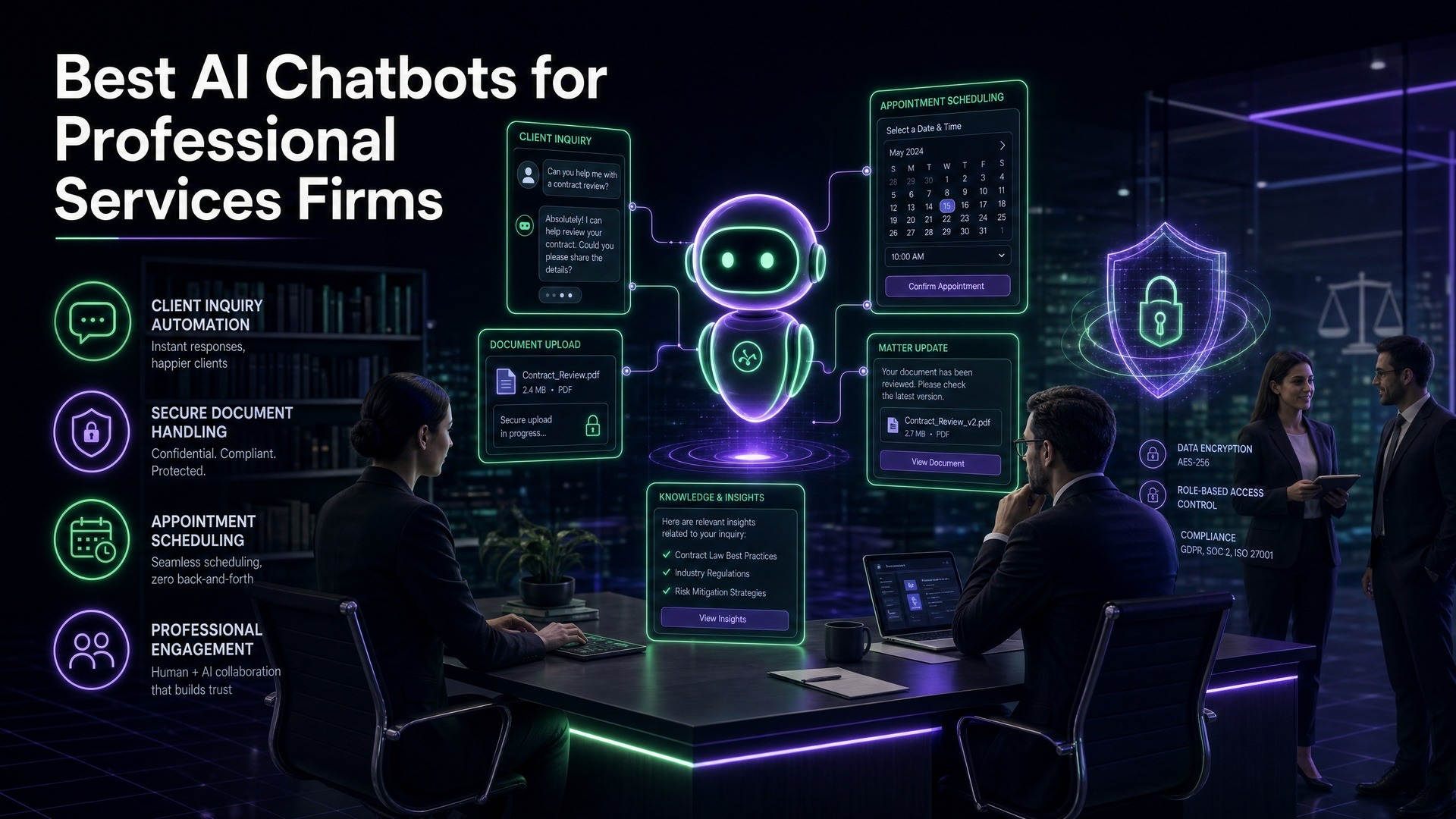
In today's competitive landscape, professional services firms—from legal practices and financial advisors to marketing agencies and IT consultants—are constantly seeking innovative ways to enhance efficiency, improve client satisfaction, and drive growth
This article delves into the critical role of AI chatbots specifically tailored for the unique demands of professional services, exploring how they address key challenges and deliver tangible benefits.
Why Professional Services Need AI Chatbots
Professional services firms operate in an environment characterized by high-value interactions, complex information, and often, time-sensitive demands. Traditional client communication channels, while essential, can become bottlenecks, leading to delayed responses, missed opportunities, and increased operational costs. This is where AI chatbots prove invaluable.
Consider the typical scenarios: a prospective client needs immediate information about your services outside business hours, an existing client has a routine query about their account, or your team is inundated with repetitive questions that divert attention from high-impact work. AI chatbots can seamlessly handle these interactions, providing instant, accurate responses 24/7. This not only significantly improves response times but also frees up valuable human resources to focus on complex, strategic tasks that require human expertise and empathy.
For instance, a law firm can use a chatbot to answer FAQs about legal processes, gather initial case details, and pre-qualify potential clients. A marketing agency can deploy a chatbot to explain service offerings, collect project requirements, and even provide basic estimates. The result is a more agile, responsive, and ultimately, more profitable operation. Data consistently shows that businesses that offer instant support experience higher customer satisfaction rates and improved lead conversion.
Handling Sensitive Client Information Securely
One of the foremost concerns for professional services firms when considering AI integration is the security and confidentiality of client data. Firms dealing with legal, financial, or proprietary business information cannot compromise on data protection. Therefore, any AI chatbot solution must incorporate robust security measures.
A critical aspect is ensuring that the chatbot platform is compliant with relevant industry regulations such as GDPR, HIPAA (for healthcare-related consulting), CCPA, and others pertinent to your geographical location and industry. This includes data encryption both in transit and at rest, secure data storage practices, and strict access controls. Firms must scrutinize a chatbot provider's security protocols, including their data handling policies, data residency options, and any third-party certifications (e.g., ISO 27001).
Furthermore, the architecture of the chatbot itself should minimize the exposure of sensitive data. This often involves anonymizing data where possible, employing tokenization for personally identifiable information (PII), and ensuring that the AI models are trained and operate within a secure, isolated environment. Platforms like QuickWise, which allow firms to build chatbots based on their own internal, company-specific data, offer an inherent advantage. This approach ensures that the AI's knowledge base is directly controlled by the firm, reducing reliance on external, potentially less secure, public data sources. An integrated ticketing system further enhances security by allowing seamless escalation to human agents when sensitive or complex issues arise, ensuring that no confidential information is inappropriately handled by the AI.
Automating Appointment Scheduling and Lead Qualification
The sales and onboarding processes in professional services are often resource-intensive. AI chatbots can revolutionize these stages by automating key tasks like appointment scheduling and lead qualification, significantly improving efficiency and conversion rates.
Appointment Scheduling: Instead of multiple email exchanges or phone calls to find a suitable meeting time, a chatbot can integrate directly with your team's calendars (e.g., Google Calendar, Outlook Calendar). Prospects can simply interact with the chatbot, select a service, view available slots, and book an appointment instantly. The chatbot can also send automated reminders, reducing no-shows. This streamlines the initial client engagement, making it easier for potential clients to connect with your firm.
Lead Qualification: Not all inquiries lead to viable business. Manually sifting through unqualified leads consumes valuable time. An AI chatbot can be programmed to ask a series of pre-qualifying questions based on your firm's criteria (e.g., project budget, specific needs, timeline, company size). Based on the responses, the chatbot can then:
Direct highly qualified leads to a human expert for immediate follow-up.
Provide relevant resources or information to warm leads.
Politely inform unqualified leads that your services may not be a fit, saving your team from pursuing dead ends.
This intelligent pre-screening ensures that your sales team spends their time engaging with prospects who are most likely to convert, thereby maximizing their productivity and increasing the overall efficiency of your lead generation efforts.
Top Chatbot Features for Consultants and Agencies
For consultants and agencies, the ideal AI chatbot goes beyond basic FAQ answering. It acts as an extension of their team, capable of handling diverse client interactions with precision and professionalism. Here are critical features to look for:
Feature Category | Specific Feature | Benefit for Professional Services |
Knowledge Base | Data-Driven Answers | Chatbot trained exclusively on firm's internal documents (service descriptions, case studies, FAQs, policies) ensures accurate, branded responses. QuickWise's "based on company data in 5 minutes" is key here. |
Integration | CRM/CMS Integration | Seamlessly pulls client history, updates records, and personalizes interactions. |
Calendar Integration | Automates appointment booking directly into team calendars. | |
Ticketing System Integration | Smooth escalation to human agents with full conversation context (like QuickWise's built-in system), preventing information loss. | |
Interaction | Natural Language Processing (NLP) | Understands complex queries, nuances, and intent, providing human-like conversational experience. |
Multilingual Support | Caters to diverse client bases, expanding market reach. | |
Proactive Engagement | Initiates conversations based on user behavior (e.g., time spent on a service page), offering assistance. | |
Management | Answer Correction System | Allows administrators to review and refine chatbot responses, continuously improving accuracy and quality (a core QuickWise feature). |
Performance Analytics | Provides insights into popular queries, unresolved issues, and user satisfaction, guiding optimization. | |
No-Code/Low-Code Interface | Enables non-technical staff to build, manage, and update the chatbot easily, reducing reliance on IT. |
These features collectively empower professional services firms to deliver highly efficient, personalized, and secure client support, reinforcing their reputation for excellence.
Comparing Chatbot Platforms for Professional Services
When evaluating chatbot platforms, professional services firms must look beyond generic capabilities and focus on features that directly address their specific operational and compliance needs. The market offers a range of solutions, but key differentiators emerge when considering the unique requirements of this sector.
A primary consideration is the ease of implementation and management. Platforms that offer a no-code or low-code interface are particularly attractive, as they allow firms to deploy and update their chatbots without extensive technical expertise or reliance on a dedicated IT team. QuickWise, for instance, highlights its ability to create AI chatbots based on company data in just 5 minutes, a significant advantage for busy firms.
Another crucial aspect is the chatbot's ability to learn and adapt. While many platforms offer AI capabilities, the mechanism for continuous improvement varies. An "answer correction system" is paramount for professional services, as it allows firms to maintain strict control over the accuracy and tone of the chatbot's responses. This ensures that the AI always reflects the firm's brand voice and delivers precise, compliant information. Without such a system, inaccuracies can persist, potentially undermining client trust.
Furthermore, the integration capabilities of the chatbot platform are vital. For professional services, a chatbot must seamlessly connect with existing CRM systems, calendaring tools, and, critically, a robust ticketing or helpdesk system. An integrated ticketing system, like the one offered by QuickWise, ensures that complex or sensitive queries can be smoothly escalated to human agents without losing context or requiring the client to repeat information. This creates a unified and efficient support experience, bridging the gap between automated and human interaction.
Finally, firms must scrutinize the vendor's commitment to security and compliance, as discussed earlier. A platform built with data privacy at its core, offering transparent data handling policies and industry-specific compliance certifications, should be a non-negotiable requirement.
Implementing AI Support While Maintaining a Human Touch
The fear that AI will dehumanize client interactions is a common concern. However, when implemented strategically, AI chatbots can actually enhance the human touch by freeing up human experts to focus on interactions that truly require empathy, nuanced understanding, and complex problem-solving. The key lies in a hybrid approach.
Here's how to strike that balance:
1. Define Clear Boundaries: Use the chatbot for routine, repetitive, and informational queries. For example, answering FAQs, providing directions, booking initial consultations, or gathering preliminary client information. Reserve human agents for complex problem-solving, sensitive discussions, relationship building, and strategic advice.
2. Seamless Escalation: Ensure your chatbot has a clear and easy mechanism to transfer a conversation to a live human agent. This is where an integrated ticketing system becomes indispensable. When the chatbot encounters a query it cannot resolve, or if a client