Top AI Chatbot Technology Trends to Watch in 2026
The landscape of customer support is in constant flux, driven by evolving customer expectations and rapid technological advancements. As businesses strive for efficiency, cost reduction, and superior customer experiences, AI chatbots have transitioned from experimental tools to indispensable components of modern customer service strategies.
Understanding these trends is crucial for any business aiming to maintain a competitive edge and optimize its customer interaction strategy.
The Evolution of AI Chatbots: From Scripted to Generative
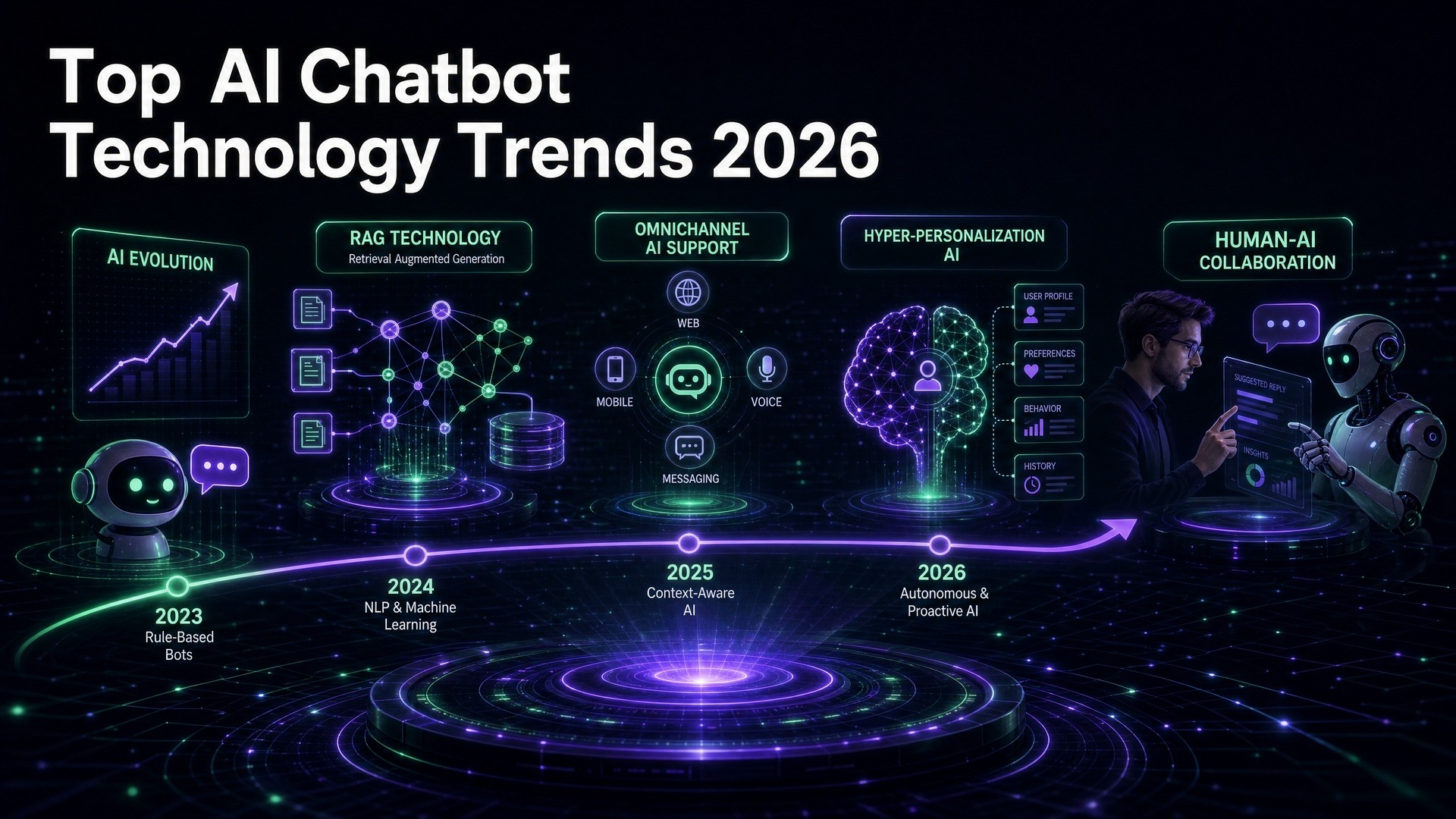
To truly appreciate where AI chatbots are headed, it's essential to acknowledge their journey. Early chatbots, often referred to as "rule-based" or "scripted," operated on predefined logic trees. Their utility was limited to answering frequently asked questions (FAQs) with exact matches, lacking the ability to understand nuances or handle complex queries. This often led to frustrating user experiences and quick escalations to human agents.
The advent of Natural Language Processing (NLP) marked a pivotal shift, allowing chatbots to understand user intent rather than just keywords. However, the real game-changer has been the rise of Generative AI, specifically Large Language Models (LLMs). These models enable chatbots to not only understand but also generate human-like text, engage in more natural conversations, and provide nuanced responses. This leap from simple automation to conversational intelligence has unlocked unprecedented possibilities for customer support, allowing chatbots to handle a wider array of interactions, personalize responses, and even learn from past conversations.
By 2026, the distinction between scripted and generative chatbots will largely blur, with generative capabilities becoming the default expectation. Businesses that have yet to transition to generative AI will find themselves at a significant disadvantage, struggling to meet customer demands for instant, intelligent, and comprehensive support.
Advancements in Retrieval-Augmented Generation (RAG)
While LLMs offer impressive generative capabilities, they come with inherent challenges, notably the potential for "hallucinations" – generating factually incorrect or nonsensical information. This is where Retrieval-Augmented Generation (RAG) becomes critical, and its advancements will be a cornerstone of AI chatbot technology in 2026.
RAG models address the hallucination problem by combining the generative power of LLMs with a retrieval mechanism. Instead of relying solely on their pre-trained knowledge, RAG-powered chatbots first retrieve relevant information from a trusted, up-to-date knowledge base (e.g., company documentation, product manuals, internal databases). This retrieved information then "augments" the LLM's generation process, ensuring responses are accurate, relevant, and grounded in verifiable data.
For businesses, RAG means:
· Higher Accuracy:Significantly reduces the risk of incorrect information, building greater customer trust.
· Up-to-Date Information:Ensures chatbots always provide the latest product details, policies, or troubleshooting steps by pulling from live data sources.
· Reduced Training Costs:Less reliance on constant fine-tuning of LLMs; instead, focus on maintaining a robust and organized knowledge base.
· Domain-Specific Expertise:Enables chatbots to become highly specialized in a company's specific products and services, acting as expert guides.
QuickWise, for instance, leverages this principle by allowing businesses to create AI chatbots based on their own company data in minutes. This direct integration with proprietary information is exactly the type of RAG advancement that will define leading customer support solutions in 2026. Expect more sophisticated retrieval mechanisms, multi-modal RAG (incorporating images, videos), and real-time data integration to become standard.
The Rise of Omnichannel AI Support
Customers today interact with businesses across numerous channels: websites, mobile apps, social media, email, and traditional phone calls. The expectation is a seamless, consistent experience regardless of the chosen channel. This is where omnichannel AI support comes into play, and it will be a dominant trend by 2026.
Omnichannel AI means that the chatbot's interaction history, context, and understanding of the customer are maintained and accessible across all touchpoints. A customer might start a conversation on a website, switch to a mobile app, and then follow up via email, all without losing the thread of the interaction or having to repeat themselves.
Key aspects of omnichannel AI support in 2026 will include:
· Unified Customer View:AI systems will maintain a single, comprehensive view of each customer's interactions across all channels.
· Contextual Handoffs:When a human agent takes over, they will have full visibility into the AI's conversation history and context, eliminating repetitive questioning.
· Proactive Engagement:AI will be able to initiate conversations on preferred channels based on customer behavior or predefined triggers.
· Channel Optimization:AI will intelligently route queries to the most appropriate channel or agent based on complexity and customer preference.
This integrated approach not only enhances customer satisfaction but also significantly boosts operational efficiency by reducing friction and ensuring faster resolution times.
Hyper-Personalization in Customer Interactions
Generic responses are a relic of the past. By 2026, customers will demand, and AI chatbots will deliver, hyper-personalized interactions. This goes beyond simply using a customer's name; it involves tailoring responses, recommendations, and even the tone of communication based on a deep understanding of the individual customer.
Hyper-personalization will be driven by:
Customer Data Integration: AI chatbots will seamlessly integrate with CRM systems, purchase history, browsing behavior, and past support interactions.
Predictive Analytics: AI will anticipate customer needs and questions before they are explicitly asked, offering proactive solutions or relevant information.
Sentiment Analysis: Chatbots will accurately gauge customer emotions (frustration, satisfaction, urgency) and adjust their responses and escalation paths accordingly.
Adaptive Learning: The AI will continuously learn from each interaction, refining its understanding of individual customer preferences and improving its ability to personalize future engagements.
Imagine a chatbot suggesting a specific product upgrade based on your usage patterns, or offering troubleshooting steps tailored to the exact model of device you own, having retrieved this information from your account history. This level of personalized service will differentiate leading businesses.
Improved Handoff Protocols Between AI and Humans
While AI chatbots are becoming increasingly capable, complex, sensitive, or unique issues will always require human intervention. The efficiency and quality of these AI-to-human handoffs will be a critical differentiator in 2026. No longer will a customer be subjected to repeating their issue after being transferred.
Improved handoff protocols will feature:
Seamless Context Transfer: When an AI chatbot escalates a query, it will automatically provide the human agent with a comprehensive summary of the conversation, including the customer's issue, attempted solutions, and relevant account details.
Intelligent Routing: AI will not just transfer to "a human" but to the most appropriate* human agent or department based on the query's nature, the agent's expertise, and their current availability.
Integrated Workflows: The ticketing system will be deeply integrated with the chatbot platform, automatically creating tickets with pre-filled information upon escalation. QuickWise's integrated ticketing system is an example of this forward-thinking approach.
Feedback Loops: Mechanisms will be in place for human agents to provide feedback on AI performance, helping to train and improve the chatbot's ability to handle similar queries in the future. QuickWise's answer correction system exemplifies this, empowering agents to refine AI responses and continuously improve accuracy.
This streamlined handoff process ensures that customers receive efficient resolution and human agents are empowered with all the necessary information, reducing their workload and improving their job satisfaction.
What the Future Holds for Customer Support Automation
The trends outlined above paint a clear picture: customer support automation in 2026 will be defined by intelligence, integration, and personalization. Businesses that embrace these advancements will not only reduce operational costs but also foster deeper customer loyalty and satisfaction.
The focus will shift from merely automating simple tasks to creating truly intelligent virtual assistants that can:
Proactively address customer needs: Moving beyond reactive support to predictive engagement.
Act as expert guides: Providing comprehensive, accurate, and context-aware information.
Seamlessly integrate into the entire customer journey: From sales and onboarding to support and retention.
Continuously learn and adapt: Becoming more effective with every interaction.
For platforms like QuickWise, the emphasis will continue to be on empowering businesses to harness these sophisticated AI capabilities without requiring deep technical expertise. The ability to deploy advanced AI chatbots based on proprietary data in minutes, coupled with robust ticketing and correction systems, will be paramount.
In conclusion, the future of customer support is undeniably AI-driven. Businesses that invest in understanding and implementing these AI chatbot technology trends will be well-positioned to meet the evolving demands of their customers and thrive in an increasingly competitive market. The time to act is now, transforming customer support from a cost center into a strategic differentiator.