How to Quickly Fix Wrong Answers in AI Chatbots
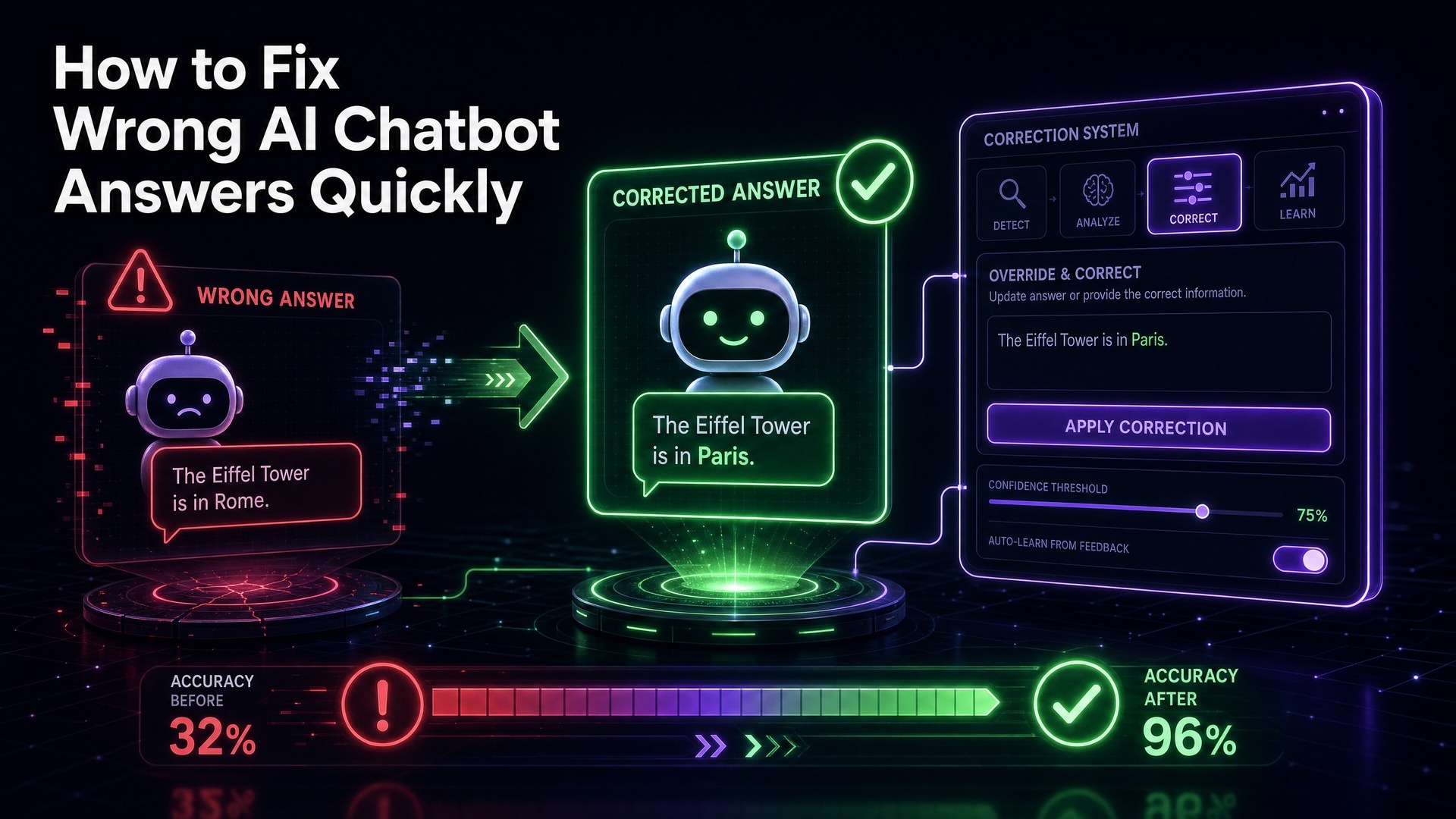
In the rapidly evolving landscape of customer support, AI chatbots have become indispensable tools for businesses aiming to enhance efficiency and customer satisfaction. However, a persistent challenge remains: the dreaded "AI hallucination" or, more simply, wrong answers. When a chatbot provides inaccurate information, it doesn't just frustrate customers; it erodes trust, increases churn, and can even lead to significant operational bottlenecks. For B2B SaaS companies, where precision and reliability are paramount, addressing this issue swiftly and effectively is not merely an option—it's a business imperative.
Why Do AI Chatbots Give Wrong Answers?
Understanding the root causes of incorrect chatbot responses is the first step toward effective remediation. AI chatbots, particularly those leveraging Large Language Models (LLMs), are complex systems, and their propensity for error stems from several factors:
Data Quality and Quantity:The foundation of any AI model is its training data. If this data is incomplete, outdated, contradictory, or of poor quality, the chatbot will inevitably generate flawed responses. Insufficient data can lead to generalizations, while biased data can propagate misinformation.
Lack of Contextual Understanding:While LLMs are excellent at pattern recognition and language generation, they often struggle with true contextual understanding, especially in nuanced or highly specific B2B environments. They might correctly interpret keywords but miss the underlying intent or specific business rules.
Over-reliance on Generative Capabilities (Hallucinations):This is perhaps the most vexing issue. LLMs are designed to generate human-like text, and sometimes, when they lack specific information, they "hallucinate"—they confidently create plausible-sounding but entirely false information. This is not malicious; it's a byproduct of their design to always provide an answer.
Outdated Information:Business processes, product features, and policies change frequently. If the chatbot's knowledge base isn't updated in real-time, it will continue to provide old, incorrect information, leading to customer frustration and potential compliance issues.
Ambiguous User Queries:Users don't always articulate their needs clearly. Ambiguous or poorly phrased questions can confuse the chatbot, leading it to guess or misinterpret the user's intent, resulting in an irrelevant or incorrect answer.
System Integration Issues:If the chatbot is integrated with other systems (e.g., CRM, ticketing), errors can arise from data synchronization problems, API failures, or incorrect data mapping between systems.
The Danger of AI Hallucinations in Customer Support
The consequences of an AI chatbot delivering wrong answers extend far beyond a mere inconvenience. In a B2B SaaS context, these "hallucinations" can have significant, quantifiable negative impacts:
Erosion of Customer Trust:For businesses, trust is a critical currency. A single incorrect answer can shatter a customer's confidence in your support system and, by extension, your brand. This directly impacts retention and upsell opportunities.
Increased Support Load and Costs:When a chatbot fails, customers inevitably escalate to human agents. This defeats the primary purpose of automation, increasing ticket volumes for your human team, driving up operational costs, and lengthening resolution times.
Negative Brand Perception:Inaccurate information can quickly spread through social media or industry forums, damaging your reputation and making it harder to acquire new customers.
Compliance and Legal Risks:In regulated industries, incorrect advice or information provided by a chatbot could lead to serious compliance violations, fines, or even legal action.
Decreased Customer Satisfaction (CSAT) and Net Promoter Score (NPS):Dissatisfied customers are less likely to recommend your service and more likely to churn. Incorrect chatbot responses are a direct pathway to lower CSAT and NPS scores.
Lost Revenue Opportunities:If a chatbot provides incorrect product information or troubleshooting steps, it can hinder a customer's ability to use your product effectively, potentially leading to churn or preventing them from upgrading to higher tiers.
Consider the following impact metrics:
Impact Area | Consequence of Wrong Answers | Quantifiable Effect |
Customer Trust | Loss of confidence in support and product | Reduced customer lifetime value (CLTV), higher churn rates. |
Operational Efficiency | Increased human agent workload, longer resolution times | Higher support costs (salaries, infrastructure), decreased agent productivity. |
Brand Reputation | Negative reviews, social media backlash, diminished credibility | Lower conversion rates for new leads, difficulty in talent acquisition, increased marketing spend to counteract negative sentiment. |
Revenue | Churn, failure to upsell/cross-sell, customer disputes | Direct revenue loss, potential refunds, missed expansion opportunities. |
Compliance | Regulatory fines, legal disputes | Significant financial penalties, legal fees, reputational damage, operational disruption. |
How Corrections Systems Work
To combat the issue of wrong answers, advanced AI chatbot platforms integrate sophisticated "correction systems." These systems are designed to provide a robust feedback loop, allowing businesses to identify, analyze, and rectify inaccuracies quickly.
At its core, a correction system operates on the principle of human-in-the-loop validation. When a chatbot provides an answer, especially one that leads to an escalation to a human agent, the system captures this interaction. Key components include:
1. Feedback Mechanisms:
User Feedback:Simple "Was this helpful?" buttons or thumbs-up/down options allow customers to flag incorrect or unhelpful answers directly.
Agent Feedback:When a human agent takes over a conversation, they can explicitly mark the chatbot's previous answer as incorrect, irrelevant, or insufficient. They can also provide the correct answer or point to the relevant knowledge base article.
2. Automated Anomaly Detection: Some systems use AI to monitor conversation patterns. For example, if a chatbot gives an answer, and the customer immediately rephrases the question or expresses dissatisfaction, it might flag that interaction for review.
3. Correction Interface: A dedicated dashboard or interface allows administrators to review flagged answers. For each flagged interaction, the system typically displays:
The user's original query.
The chatbot's generated answer.
The context of the conversation.
The reason for the flag (if provided).
The human agent's corrected response (if applicable).
4. Knowledge Base Integration: Once an incorrect answer is identified and the correct information is determined, the correction system facilitates updating the underlying knowledge base or training data. This might involve:
Directly editing the specific FAQ entry.
Adding new Q&A pairs.
Refining the source documents the LLM draws from.
5. Retraining and Deployment: After corrections are made, the system can either instantly update the chatbot's response for that specific query or trigger a partial retraining process to integrate the new information across the model, ensuring the error doesn't recur. The goal is to deploy these corrections almost immediately, minimizing the window of incorrect information dissemination.
The speed of this correction loop is critical. A system that allows for real-time or near real-time corrections drastically reduces the cumulative impact of wrong answers, transforming potential liabilities into learning opportunities.
Using FAQ Prioritization for Critical Answers
While correction systems handle reactive fixes, FAQ prioritization offers a proactive strategy to minimize critical errors. Not all questions are created equal; some answers carry more weight in terms of business impact, compliance, or customer satisfaction. FAQ prioritization involves identifying and giving special treatment to these high-stakes answers.
The process typically involves:
1. Identification of Critical FAQs: Work with product, legal, and customer success teams to identify questions where an incorrect answer could lead to:
Financial loss (e.g., pricing, billing, refund policies).
Compliance violations (e.g., data privacy, regulatory guidelines).
Significant customer frustration or churn (e.g., core product functionality, account access).
Safety concerns.
2. Tiered Knowledge Base: Organize your knowledge base into tiers based on criticality. For example:
Tier 1 (Critical):Absolutely must be accurate.
Tier 2 (Important):Should be accurate, but less severe impact if slightly off.
Tier 3 (General):Common questions, lower risk.